

Don't Plan Your Week...Score It
Planning fills your calendar with slots. Scoring shapes it like a piece of music — with space, restraint, and every note placed to serve what matters most.
I'll admit a small indulgence up front: I have a real soft spot for film music. Give me a well-scored movie and I'll notice the music long after I've forgotten half the plot. And the thing that fascinates me about the craft — the John Williamses and Alan Silvestris of the world — is what they don't do. A great film composer doesn't fill every second with sound. They use silence. They hold back. They place a theme exactly where it will do the most good and let the quiet stretches carry their own weight. The music isn't there to show off. It's there to serve the picture.
Hold onto that image, because it's the whole point of how I want you to think about your week.
Planning fills slots. Scoring serves a story.
Most people treat their calendar like a cluttered inbox — reactive, chaotic, stuffed with whatever obligations shouted loudest. That's planning in the worst sense: filling slots until there's no air left. And a week built that way produces exactly what random acts of prospecting always produce — a lot of motion, not much music.
Scoring is a different act entirely. When you score your week, you place your blocks of focused work the way a composer places notes on a staff — intentionally, with space between them, each one chosen to support the larger piece. You're not trying to cover every line. You're arranging a handful of deliberate placements so the whole thing has rhythm: flow, movement, and room for your most important work to actually sound. That's not hustling harder. It's the opposite. It's arranging less, but on purpose.
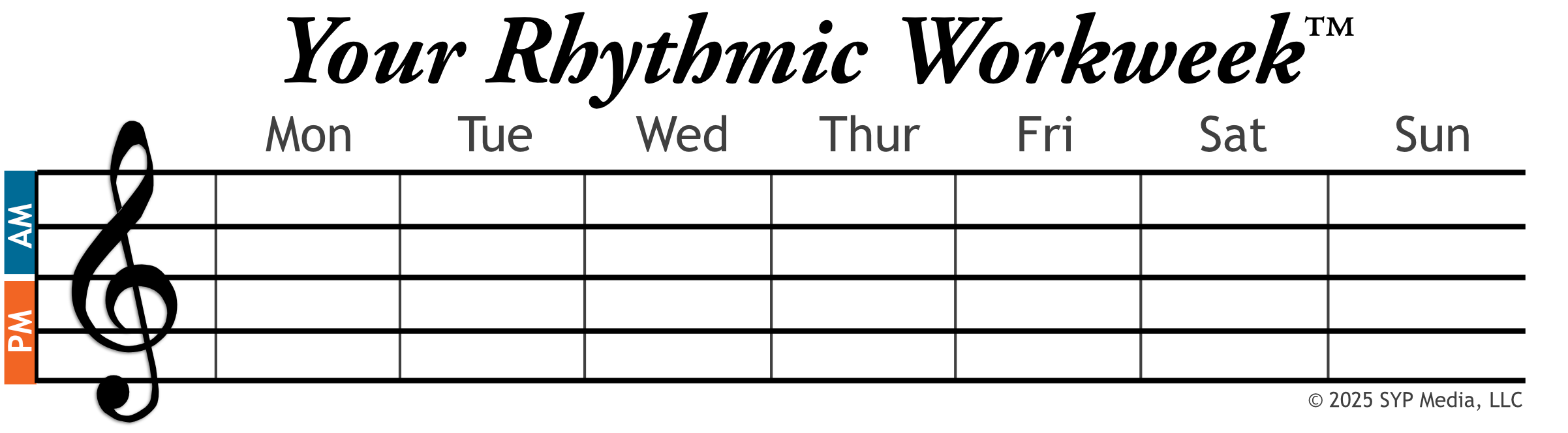
Look at that grid for a second and let the resemblance sink in. The days are your measures. The AM and PM rows are your staff lines. Right now it's silent — an empty score, waiting. What you write onto it is up to you, and the temptation will be to cram it. Resist that. A page of music crowded with notes on every line isn't rich; it's noise. The best scores — like the best weeks — are mostly defined by what the composer chose to leave open.
Not every note is a long one
Here's a piece of this that trips people up. They assume scoring a week means finding big, heroic blocks of time, and when they can't find enough of them, they give up. But not every note in a score is a whole note. Some of your most valuable moves take five focused minutes — circling back with a warm lead, following up on a quiet referral, sending the note you keep meaning to send. Those are your quarter notes and grace notes, and they matter enormously.
In fact, the work that gets pushed off the most is often the work that matters most, precisely because it's small enough to feel skippable. So you place it on the staff on purpose. A short, deliberate note, dependably struck, will out-produce the heroic marathon you keep meaning to schedule and never do — which is the same reason we say as little as twenty focused minutes a day can carry a whole practice. Long or short, what makes it music is that you placed it with intention.
How you actually score a week
I won't pretend a paragraph can teach you the full method — scoring a week well takes a bit of practice, and inside the program we walk through it with a proper worksheet and a fair amount of hands-on guidance. But so you can see the shape of it, the movement runs roughly like this:
- Reframe your calendar as a musical staff — a canvas to compose on, not an inbox to survive.
- Place your focused blocks with intention — chosen in advance, positioned where your energy is best.
- Design your environment so the block can actually hold — distractions closed off before you begin.
- Log it, don't judge it — mark that you showed up, the way you'd honor any imperfect action, and move on.
- Tie every block back to your handful of core priorities, so the score is always serving the picture.
That's the melody line, not the full arrangement. If it stirs something in you — a sense that your week could sound like a piece of music instead of a fire drill — that instinct is worth following. The full method, and the worksheet that makes it real, live inside the program, where we can actually train you to deploy it rather than just admire it.
How Prospect & Flourish approaches this
We anchor all of this in music rather than in machinery on purpose, and it's not just a pretty metaphor. Machines run on pressure — more input, more output, fill every cycle. Music runs on something else: intention, tempo, and the wisdom to leave space. A calendar treated like a machine will grind you down. A week treated like a score will carry you. What this means to you is a genuine shift in how you hold your own time: you stop reacting to a cluttered page and start composing a deliberate one. You won't get it perfect, and you're not meant to — even the greatest scores get revised. But the moment you start placing your notes on purpose instead of letting the noise fill the staff for you, your week begins, quietly, to make music.
Frequently asked questions
My week is far too unpredictable to score. Doesn't this only work for people with calm schedules?
I'd actually argue the opposite — the more chaotic your week, the more you need to score it, not less. Scoring isn't about controlling every hour; it's about protecting a few of them from the chaos that would otherwise take all of them. You're not composing a rigid symphony that shatters the moment something interrupts. You're placing a handful of intentional notes and letting the improvisation happen around them. Unpredictable weeks are exactly where an unscored calendar disappears into reaction. A few protected, deliberate placements are how you keep some music in a week that would otherwise be all noise.
Isn't this just time-blocking with a musical metaphor stapled on?
The mechanics overlap, sure — but the mindset is the whole difference, and the mindset is what determines whether it works. Ordinary time-blocking tends toward filling: cover the calendar, account for every hour, feel productive. Scoring is about restraint and intention: placing few things, leaving deliberate space, and judging the week by its rhythm rather than its fullness. If the metaphor helps you stop cramming and start composing, it's earned its keep. If you'd block your calendar solid and call it scored, you've missed the point the metaphor exists to make.
Do I need the worksheet to do this, or can I start now?
Start now — you don't need anything but your existing calendar and a willingness to place a couple of blocks on purpose this week. The worksheet and the fuller method inside the program will make it sharper and easier to sustain, and honestly they take a little training to deploy well, which is why I'm not going to hand you a form and pretend that's the same as learning to use it. But don't let “I don't have the tool yet” become one more reason to wait. Score one day this week. The instrument you already have is enough to begin.
What happens when I miss my scored blocks — doesn't the whole thing fall apart?
No more than a live performance falls apart when one note gets missed. You don't stop the piece and start the week over; you find the beat again and keep playing. A scored week is meant to be resilient, not brittle — the point was never a flawless performance, it was a dependable rhythm you can return to. Some weeks you'll hit most of your notes; some weeks you'll drop half of them. Both are still music, as long as you keep coming back to the staff. The failure isn't a missed block. It's abandoning the score entirely because it wasn't perfect.
Hero illustration created with AI, art-directed by Keith F. Luscher. Rhythmic Workweek™ grid © SYP Media, LLC.