
Focus is a Structure, Not a Mood
If you wait until you feel focused, you'll wait forever. Focus isn't something you summon. It's something you build — on purpose, and in advance.
Let me name a pattern you'll recognize, because I've lived it and so has everyone I've ever coached. You've got important work to do — the kind that actually moves your business — and you tell yourself you'll get to it when the moment is right. When the inbox is clear. When you're feeling sharp. When the chaos settles down and you have the perfect stretch of uninterrupted time. So you wait for that moment. And it doesn't come. It almost never comes.
That's not a scheduling problem. It's a thinking problem, and it starts with a single false assumption: that focus is a mood you have to feel before you can work. Anything that's dependent on waiting for a feeling is, in my book, mistake number one. It's the productivity equivalent of getting ready to get ready — forever preparing to begin, never quite beginning.
Focus is not a mood
Here's the reframe that changes everything. Focus isn't a feeling. It's a structure. You don't summon it; you design it. This is really just a specific application of a principle we lean on all through this work: you don't go with what you feel — you go with what you know. And what you know is that the work matters, that you're the one who has to do it, and that your feelings on any given morning are lousy predictors of what you're actually capable of once you sit down and start. Waiting to feel focused hands the keys to the least reliable part of you. Designing your focus takes them back.
You don't need more hours. You need protected space.
Notice what the answer is not. It's not more time — you almost certainly have enough hours; they're just leaking out through distraction. What you need is protected space: a guarded block of time where you're fully present, undistracted, and locked onto one thing that matters. In this program we call that a Focus Time Block, and it has four honest features. It's intentional — you decide the specific task in advance, not in the moment. It's time-blocked — a clear start and a clear stop, ideally somewhere in the sixty-to-ninety-minute range. It's single-task — one thing, no toggling, no “quick checks.” And it's a lead indicator — meaning the win is simply that you showed up and gave it your honest, imperfect best, regardless of how the outcome shakes out.
That last one matters more than it looks. You don't grade a Focus Time Block by whether you closed a deal or wrote something brilliant. You grade it by whether you showed up and did the work — the same reason we keep telling you to take imperfect action. Presence is the thing you control. Results follow from a hundred repetitions of presence, not from any single heroic session.
Deep work is a skill, not a lucky day
I was first introduced to this idea through Shane Melaugh and his Focus & Action training — he in turn drew on Cal Newport, who wrote a whole book making the case for what he calls deep work. What struck me, and what I want to pass along, is that Melaugh framed it not as a clever productivity hack but as a skill — something you build through consistent application, the same as any other. That reframing did a lot for me.
Because if focus is a skill rather than a mood, then two things follow. First, you're not broken if it feels hard at the start — you're just untrained, and training takes reps. Second, it will genuinely get easier the more you practice it. The expression I keep coming back to for this is: simple, but not easy. The concept fits on an index card. The doing of it, consistently, until it becomes muscle memory — that's the actual work, and it's why most people never build the skill. They keep waiting to feel like practicing.
Structure determines behavior
There's a principle underneath all of this that we established earlier in the program: structure determines behavior. This is where it finds its daily expression. You are not going to willpower your way into focus — willpower is finite and it's a big part of why most systems don't stick. Instead, you design your days and your week so that your best work has a home. A standing place to live. Not once, in a burst of inspiration, but again and again, on a dependable beat.
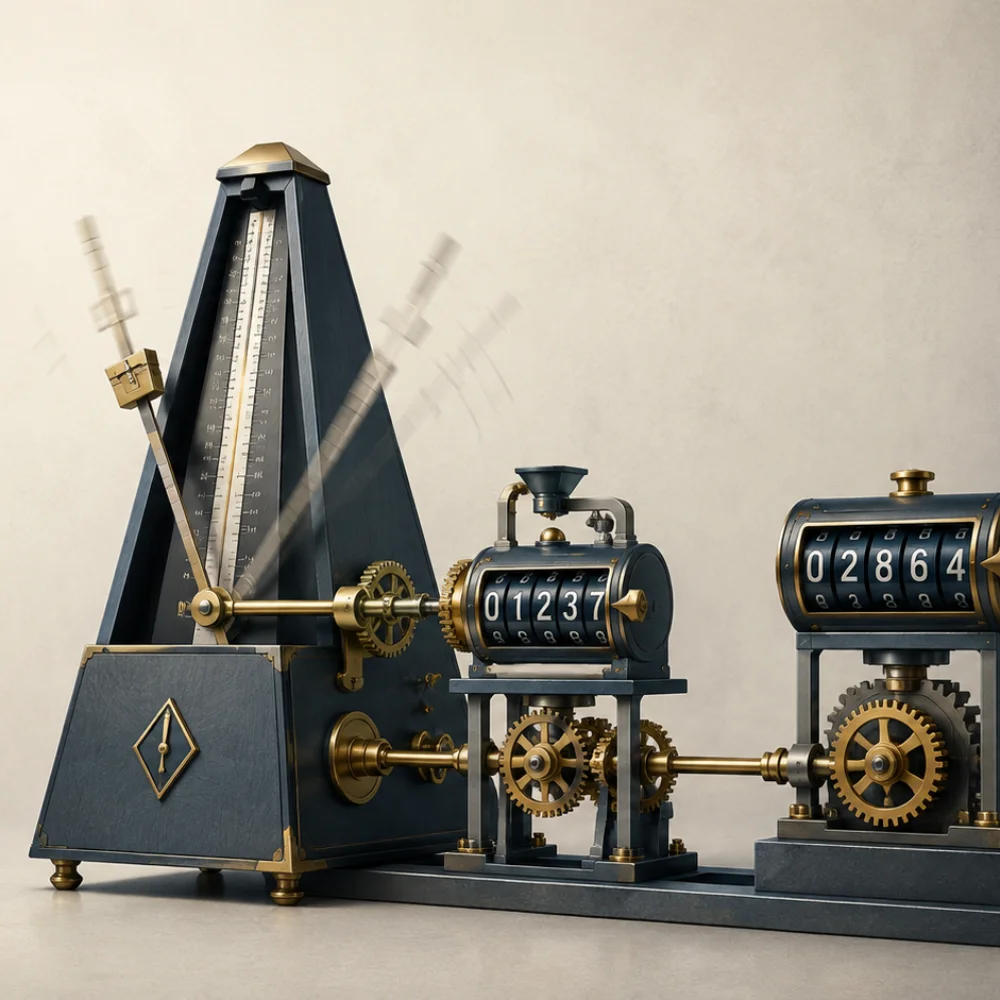
And that repetition is the whole game. The results don't come from scattered effort or from the occasional brilliant marathon. They come from the compound effect of repeated presence — showing up to the same protected block, doing the one thing, and coming back tomorrow. String enough of those together and you don't just get work done. You build a rhythm, which is the subject of everything else in this section. (How you actually lay those blocks across your week — like notes on a musical staff — is a conversation of its own, and we give it one.)
How Prospect & Flourish approaches this
We treat focus as an act of design, full stop. That's a deliberate stance, because the whole culture around productivity keeps selling the opposite — the hack, the app, the surge of motivation that supposedly makes the work feel good. What this means to you is both harder and far more freeing than any of that. Harder, because it asks you to stop negotiating with your feelings every morning and simply keep the appointment you made with your own work. Freeing, because once the time is protected and the habit is built, you no longer have to feel like focusing in order to focus. You just show up to the block, and the structure carries you. Build the container first. The focus will come to fill it.
Frequently asked questions
My days are full of interruptions — where am I supposed to find protected time?
Here's the honest answer: you don't find it, you take it. Protected time never appears on its own, because something will always expand to fill any open space you leave. You have to claim a block in advance and defend it — put it on the calendar, tell people you're unavailable, close the other tabs. It doesn't need to be long; even a single guarded block a few times a week beats waiting for a clear afternoon that never comes. And yes, you'll have to protect it against real, legitimate demands, which is uncomfortable. That discomfort is the price. There's no version of this where the time gets handed to you.
What if I sit down to focus and the focus just isn't there?
Then you do the work anyway, badly if necessary, and you let that count. This is the point of treating the block as a lead indicator: the win is showing up and giving it your honest, imperfect best, not producing something you're proud of every time. Some sessions will feel flat and unproductive — that's normal, and it's not evidence the system is failing. Focus is a skill, and skills have off days. What matters is that you kept the appointment. Do that consistently and the good sessions come far more often than they would if you only worked when inspiration showed up.
Isn't sixty to ninety minutes on one thing a lot to ask? I'm used to multitasking.
I'd gently suggest the multitasking is part of the problem, not a skill worth protecting. What most of us call multitasking is really rapid toggling, and every toggle carries a hidden cost — you pay a little tax in attention each time you switch, and those taxes add up to a day that feels busy but produces little. Single-tasking feels strange at first precisely because you're so practiced at the opposite. Start smaller if ninety minutes feels daunting — even a focused block of half that length, done as one task with the distractions closed off, will show you the difference. The length matters less than the singleness.
How is a Focus Time Block different from just time-blocking my calendar?
Mechanically they look similar, and plenty of people block their calendars without ever getting the benefit — so the difference is in the discipline, not the tool. A Focus Time Block carries three commitments an ordinary calendar entry usually doesn't: a single chosen task decided in advance, a genuine refusal to multitask during it, and a standard of success measured by showing up rather than by the outcome. Block your calendar all you like; if you spend the block answering email and toggling between tabs, you've scheduled the appearance of focus without the substance. The container only works if you actually keep it single and protected.
Illustration created with AI, art-directed by Keith F. Luscher