
Live Your Blueprint, Every Day
You've built the structure and found the rhythm. This is the last step, and the simplest: stop admiring the blueprint and start living it — today, and then again tomorrow.
If you've come this far — through the mindset work, the structure, the rhythm — then you've arrived somewhere worth pausing to notice. Not because there's a new strategy waiting here; there isn't. This is something quieter. It's a return to the center, to the thing all of it was quietly building toward. You've developed structure. You've begun to shape rhythm. Now comes the part where it all becomes real: where the blueprint stops being a document you admire and becomes a life you actually live.
A look back at the whole walk
Let me briefly retrace the ground we've covered, because the shape of it matters. Early on, we reset the foundation — moving past the old sales tropes and grounding everything in presence, integrity, and a genuine reframing of what prospecting even is: not a script to memorize or a game to win, but a practice rooted in service. From there we turned inward, confronting the patterns that hold us back and learning that structure, not hustle, is what actually determines behavior. Then we turned outward again with a steadier posture — applying real strategies, and learning that trust is earned slowly, through consistency, character, and clarity. And finally, here in this last stretch, we've anchored all of it in daily rhythm — not for the sake of productivity alone, but for the alignment of an entire life.
This walk was never really about becoming a better prospector, or marketer, or communicator. Underneath all of it, it's been about becoming more fully yourself — aligned, anchored, and available to the work that actually matters.
The purpose you didn't know you signed up for
Let me be honest with you, the way I've tried to be all along. You didn't enroll in Prospect & Flourish because you were searching for your life's purpose. You signed up because you wanted better results — more prospects, better clients, greater clarity, and yes, almost certainly, more income. All of that is real, and much of it will come, if it hasn't already. But here's the twist I owe you: all of that was the bait.
Because the real transformation waiting underneath the structure and the rhythm is alignment — with a purpose, the one you were made for. Simon Sinek made his name on the idea that people respond less to what you do than to why you do it. Rick Warren opened his most famous book with the bracing reminder that, in the end, it isn't really about us at all. One framed it for the marketplace, the other for the soul, and both point at the same truth: when you actually know why you're here, the path of least resistance gets a great deal wider. The rhythm you've been building only becomes sustainable when it's rooted in something deeper than profit or ego. Otherwise you'll drift — or worse, you'll succeed at the wrong thing.
Rhythm is how you live what you believe
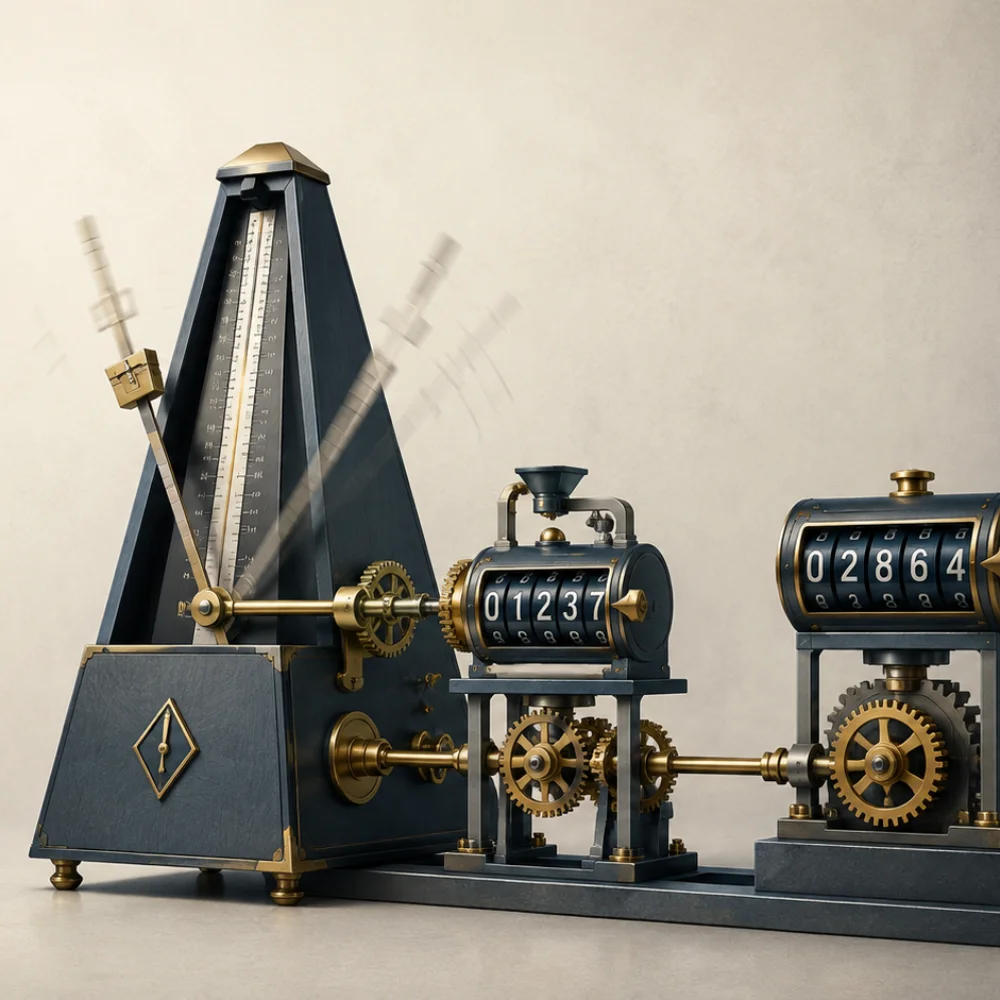
Sit with that line, because it's the whole point of this final category. Rhythm is not discipline in a nicer outfit, and it's not another word for willpower. It's something more human than either. Rhythm is the pattern that forms when your calendar, your priorities, and your deeper sense of purpose finally start moving in harmony. That's why we've anchored all of this in music rather than machinery from the beginning — machines run on pressure, but rhythms run on intention, tempo, and grace. When you establish your recurring focus, protect your time, and align it with the dimensions of a whole life, you're doing something more than getting organized. You are composing a life.
And I won't pretend it comes out clean. At first your rhythms may feel forced. The notes will be off. Life will interrupt them, you'll forget, you'll get distracted, and some weeks you'll simply fall flat. That's not failure — that's normal, and it's exactly why the whole of the last piece in this section came down to a single instruction: don't give up; show up. The rhythm survives the missed notes, as long as you keep returning to the staff.
Alignment is a practice, not a finish line
Here's the thing I most want you to carry out of this program. Alignment is not a summit you reach and then plant a flag on. It's a practice — a lifelong rhythm of re-alignment. You'll drift, you'll notice, and you'll turn back toward center, again and again, the way you return to any rhythm worth keeping. The goal was never a flawless performance. It was to close the gap between what you intend and what you actually do — and to close it not with pressure and self-flagellation, but with peace.
That gap is where most good intentions go to die. You know what you should do; the doing is the hard part — which is the whole reason we keep insisting you take imperfect action rather than wait to feel ready. Living your blueprint is nothing more, and nothing less, than closing that gap a little every day. Not perfectly. Not all at once. Just today, and then again tomorrow.
How Prospect & Flourish approaches this
So here we are, at the end of the walk — which is really just the beginning of the living. Everything in this program has pointed here: you are no longer working randomly, no longer chasing disconnected goals, no longer trying to find yourself in your work. You've moved, I hope, from random acts to something with a rhythm — and rhythm, kept faithfully, is how a blueprint quietly becomes a life. What this means to you is both smaller and larger than anything else we've discussed. Smaller, because the instruction is almost embarrassingly simple: live it, today. Larger, because doing that faithfully, every day, is how an ordinary life becomes an aligned one. You have the structure. You have the rhythm. You have the blueprint. Now go live it — not someday, not once you feel ready, but every day. That's where all of this was always headed.
Frequently asked questions
What if I've finished all this and still don't feel “aligned”?
Then you're right on schedule, honestly. Alignment isn't a feeling you unlock at the end like a trophy; it's a practice you keep returning to, and most of us never arrive at some permanent sense of having it all together. If you're drifting, you notice, and you turn back toward center — that is the practice working, not failing. I'd be more worried if you told me you felt permanently, effortlessly aligned, because that usually means you've stopped paying attention. Don't wait to feel finished. Feeling unfinished is the normal condition of a person still growing.
Isn't all this “purpose” talk a bit much for what's supposed to be a prospecting program?
I understand the reaction, and if you want to take only the tactics and leave the rest, you're free to — the tactics genuinely work. But I'd be lying to you if I stopped at technique, because I've watched too many people hit their numbers and still feel hollow, having succeeded at something they never really chose. The purpose piece isn't spiritual decoration bolted onto a sales course. It's the thing that makes the whole rhythm sustainable instead of just another system you'll abandon. You came for results. I'm simply unwilling to pretend results alone were ever the point.
How do I actually start living my blueprint tomorrow morning?
Pick one thing and do it, today, before you feel ready — because you won't feel ready, and waiting is how blueprints stay on paper. Look at the structure you've built, choose the single most important action that's genuinely yours to take, and take it, imperfectly if necessary. Then do the same the next day. You're not trying to execute the entire plan flawlessly by Friday; you're trying to close the gap between intention and action by one honest step, and then another. Living your blueprint isn't a grand relaunch. It's tomorrow morning's first small, deliberate note.
I keep starting and stopping. How do I make this one finally stick?
By changing what you count as success. Most people quit because they define sticking as never missing — and the first missed day feels like proof they've failed again, so they abandon the whole thing. But a rhythm was never a perfect streak; it's a pattern you keep returning to. Missing a day isn't breaking it. Refusing to come back is. If you can make peace with the idea that you'll fall off and simply climb back on — without the shame spiral that usually follows — you've already solved the thing that defeated you every previous time. Return, don't restart. That's what makes it stick.
Illustration created with AI, art-directed by Keith F. Luscher