
Rhythm Fulfills Structure
You worked hard to build your structure. Here's the part nobody warns you about: structure was never the destination. It was the path. Rhythm is how you walk it.
Somewhere earlier in this program, if you did the work, you built yourself a structure. You picked your priorities. You confronted the myth of willpower — the hard truth that grit and discipline are finite, and that sooner or later, we all run out of both. You sketched a blueprint for how your work ought to be shaped. That was real progress, and I don't want to diminish it.
But here's what I've watched happen more times than I can count, in my own life and in the lives of the people I've worked with. Someone builds a beautiful structure — a clear plan, a tidy calendar, the best of intentions — and then nothing moves. The blueprint sits there like an architect's drawing of a house that never gets built. And they conclude, wrongly, that they failed at planning. They didn't. They just mistook the plan for the point.
Structure was never the finish line. It was preparation. Structure creates the path; it does not walk it for you. What walks it — what turns a diagram into a lived reality — is rhythm.
So what is rhythm, exactly?
Let's be plain about the word, because it gets thrown around a lot and usually means nothing. The dictionary definition I keep coming back to is almost boringly simple: rhythm is “a regular recurrence of elements in a system of motion.” Regular recurrence. Read that again, because it's the whole thing. Not a heroic sprint. Not a burst of inspiration. A regular recurrence — the same right actions, showing up again and again, in motion.
I'll tell you what rhythm is not. It's not the grind — that joyless, white-knuckle hustle our culture keeps romanticizing. It's not irregular sprint sessions where you do everything for three days and then collapse and do nothing for two weeks (which, if we're honest, is how most people actually operate, and then wonder why nothing compounds). That pattern — feast, famine, guilt, repeat — is exactly the random acts of prospecting we've been working to leave behind since the very first unit. Rhythm is the opposite of random.
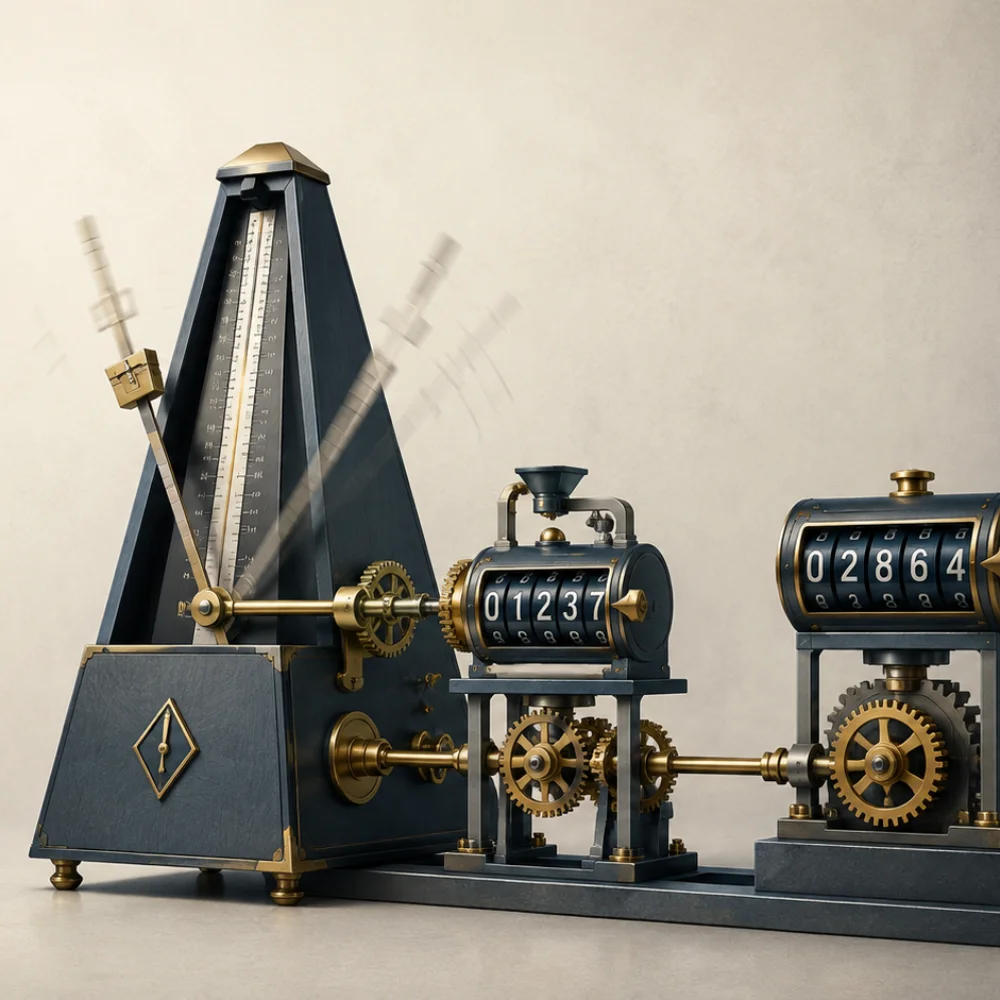
Look at the image at the top of this page for a moment. That's a metronome, and it's no accident that I've built an entire framework and visual identity around it. A metronome does exactly one thing: it keeps a steady beat, whether or not you feel like playing. Notice, in that illustration, that the metronome is geared into a set of counters, and the numbers are climbing. That's the part most people miss. The steady beat isn't the reward. The beat is what drives the count upward — slowly at first, then unmistakably. That's rhythm doing its quiet, compounding work.
Why willpower keeps letting you down
If you've ever built a system that looked great on paper and then quietly abandoned it, I'd gently suggest the problem wasn't your character. It's that the system was running on the wrong fuel. Most of the plans we make are secretly powered by willpower and motivation, and both of those are moods — they come and go with the weather, the news, how you slept, and whether the last conversation went well. Anything built on a mood will eventually crumble, because at some point the mood doesn't show up. That's not a moral failing. That's just how human beings are wired, and it's a big part of why most prospecting systems don't stick.
Rhythm solves this by taking the decision out of the moment. When something recurs on a rhythm, you're no longer asking yourself every single day whether you feel like doing it. The question has already been answered by the structure you built when you were thinking clearly. You just show up and play the note. What this means to you is simple and freeing: you stop relying on being motivated, and you start relying on being present. That's a far lighter load to carry, and it's one you can carry for years.
Do the right things. Do them right. Do them every day.
If you boil everything I know about building a sustainable working life down to its marrow, you get three short lines. Do the right things. Do them right. Do them every day. That's it. That's rhythm, stated as plainly as I can state it — and I'd argue it's the closest thing to a silver bullet that marketing, prospecting, or frankly a well-lived life has ever produced. (There's a lot packed into that little rule, and it earns its own conversation elsewhere in this section. For now, just sit with how much it asks and how little it complicates.)
The “every day” part is where most people flinch, so let me take the pressure off. It does not mean perfectly. It does not mean grimly. It means regularly — on a rhythm your structure can actually sustain. Some of those recurrences will be ninety minutes of focused work. Some will be five honest minutes circling back with someone. And on the hard days, doing the right thing might just mean showing up and being present when you'd rather not — which still counts, and counts for more than you'd think. This is the same reason we've always told you to take imperfect action: the rhythm you keep imperfectly will always beat the perfect one you keep only in your head.
How Prospect & Flourish approaches this
In this program, we treat rhythm as the bridge between the plan and the life — the thing that makes your structure real. That's why this whole final section exists, and it's why we anchor rhythm in music rather than in machinery. Machines run on pressure; rhythms run on intention, tempo, and grace. When your calendar, your priorities, and your deeper sense of purpose start to move together, you're doing something more than getting organized. You're composing a life.
And I'll be honest with you about where this ultimately points, because I'd rather you hear it from me than feel ambushed by it later. This was never really about productivity. Productivity is a fine servant and a terrible master, and rhythm is only life-giving when it flows from what matters most — not just your professional work, but your relationships, your health, and your interior life. Get the rhythm right and it does more than fill your pipeline. It aligns you. But that's the deeper end of the pool, and we'll wade in gradually. Start here: build your structure, then set it in motion. Rhythm is how the whole thing finally comes alive.
Frequently asked questions
What's the difference between structure and rhythm?
Structure is the framework — your priorities, your blueprint, the shape you've given your week. Rhythm is the regular recurrence of action inside that framework: actually doing the right things, again and again, over time. Think of structure as the sheet music and rhythm as the playing of it. You can write a gorgeous score, but until someone keeps the beat and plays the notes, there's no music. Most people over-invest in the score and never learn to keep time. This category is about learning to keep time.
Isn't this just time management with a nicer name?
That's a fair challenge, and I'll give you an honest answer: on the surface, yes, some of the mechanics overlap — calendars, blocks, priorities. But time management treats your week as a container to be filled efficiently. Rhythm treats it as something closer to a life to be composed. The goal isn't to cram in more; it's to move the right things on a sustainable, recurring beat so they compound. If all you take from this is a tidier calendar, I've undersold it. The real payoff is a way of working you can actually keep for years without burning out.
Won't a rhythm just become another rigid system I abandon in a month?
It can — and this is the honest limitation worth naming. If you build your rhythm on willpower, or you demand perfection from it, it will crack the first week life interrupts it (and life will interrupt it). The failure mode is real. What keeps rhythm from curdling into one more abandoned system is that it's designed to survive the misses. A metronome that skips a beat doesn't stop being a metronome. You don't scrap the whole thing because you had a bad Tuesday; you just pick the beat back up. Rhythm that can't absorb an off day was never rhythm to begin with.
Do I need to have my whole structure finished before I can build rhythm?
No, and waiting until everything's perfect is its own quiet trap — what I sometimes call getting ready to get ready. You need enough structure to know what your few right things are, and then you start moving them on a rhythm while the rest of the blueprint keeps taking shape. Rhythm and structure develop together, each one teaching you something about the other. Start before you feel finished. You'll learn more from three weeks of keeping an imperfect beat than from three months of refining a plan you never set in motion.
Illustration created with AI, art-directed by Keith F. Luscher